

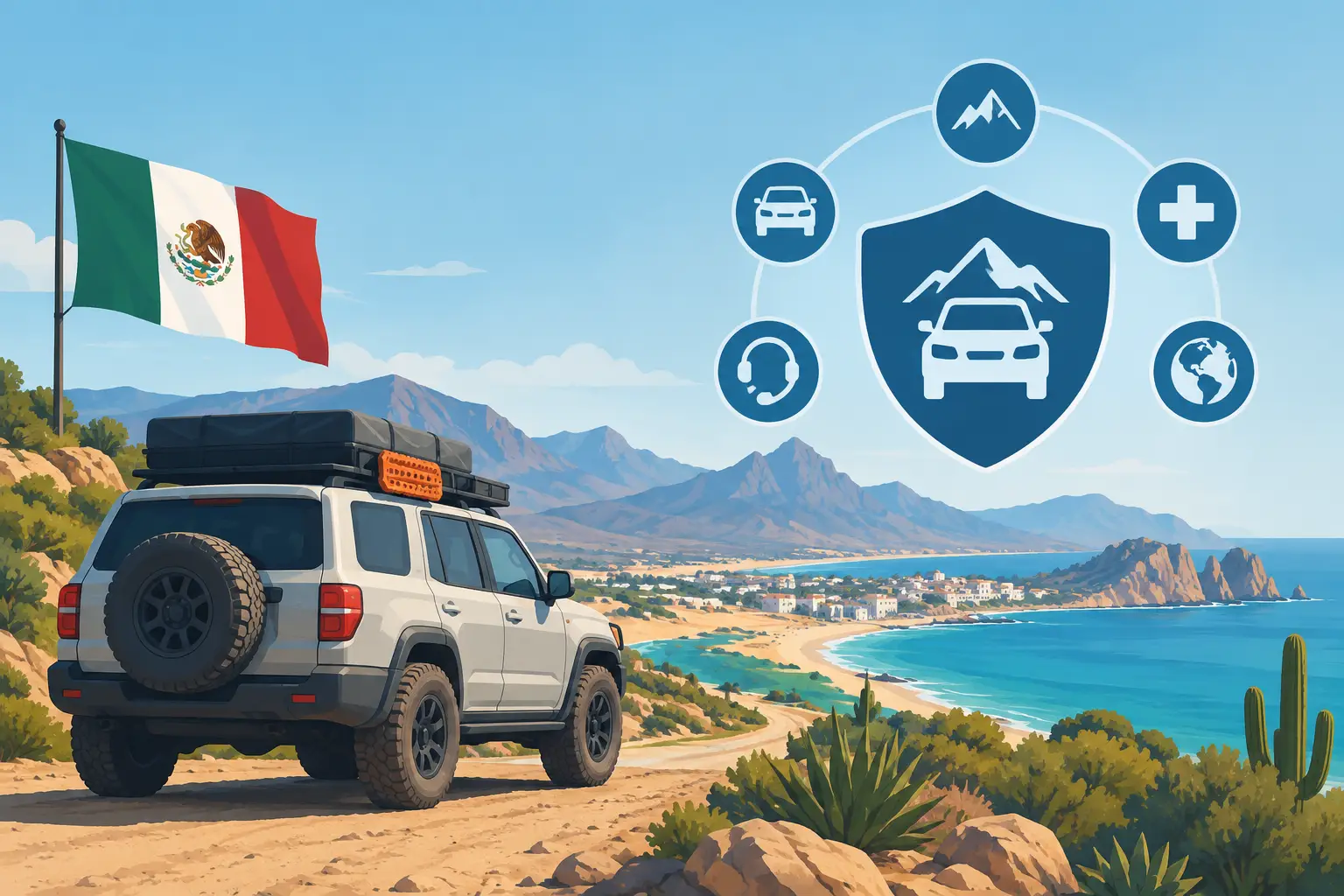
A remote Baja beach road, a mountain switchback outside Creel, or an overnight stop between border crossings can turn a minor vehicle problem into a major expense quickly. The best coverages for Mexico overlanders are not simply the cheapest policy that gets you across the border. They are the protections that address your actual exposure: Mexican liability requirements, legal responsibility after an accident, vehicle damage, theft, and the practical challenge of getting home when your trip changes unexpectedly.
For travelers who carry recovery gear, camp well beyond major cities, tow a trailer, or spend weeks at a time on Mexican roads, insurance should be part of trip planning, not a border-crossing afterthought. The right policy depends on the vehicle, its value, where you are traveling, how long you will be away, and how much financial risk you are prepared to carry yourself.
Start With Mexican Liability and Legal Defense Coverage
Mexican law requires liability coverage from a Mexican insurer. A policy issued for driving in the United States or Canada generally does not satisfy that legal requirement, even when it includes limited travel territory in Mexico. If you cause an accident in Mexico, local liability coverage is what responds to covered third-party bodily injury and property damage claims.
For overlanders, low-limit liability is rarely a good place to save money. A serious collision can involve several people, multiple vehicles, roadside property, or costly medical treatment. Look for a policy with meaningful limits, such as up to $500,000 combined single-limit liability, rather than choosing minimum coverage solely to meet the legal requirement.
Legal defense deserves the same attention. An accident in Mexico can create a legal process that is unfamiliar to US drivers, particularly if injuries are involved. Quality Mexican auto insurance can include legal assistance and legal-defense coverage, with limits such as $100,000. This coverage is designed to help address covered legal expenses and provide support through the claims process. It does not make an accident easy, but it can keep a difficult situation from becoming much more financially disruptive.
Why liability limits matter more off the main route
Overland travel often means long days, changing weather, narrow roads, livestock, unfamiliar traffic patterns, and limited access to immediate support. None of that means Mexico is uniquely unsafe. It does mean that a collision far from home can carry consequences that are harder to manage.
A higher liability limit provides a larger cushion when the unexpected happens. It is especially worth considering for travelers in heavy vehicles, motorhomes, trucks with campers, bus conversions, or rigs towing trailers. More vehicle mass can mean more potential damage in an accident, and larger rigs can be more complicated to recover or repair.
Add Physical Damage and Theft Protection for the Vehicle You Built
Liability protects others when you are responsible for a covered accident. It does not pay to repair or replace your own vehicle after a covered collision, rollover, theft, fire, or other covered loss. For many overlanders, physical damage and total theft coverage are the protections that make a trip financially workable after a major incident.
Consider what you would lose if your vehicle were damaged beyond use in Mexico. The answer is often more than the market value of a daily driver. An overlanding vehicle may include a camper shell, rooftop tent, suspension work, auxiliary batteries, recovery equipment, storage systems, and other investments. Your policy should be based on an accurate insured value and should fit the vehicle type listed on the policy.
Do not assume every accessory or modification is automatically included. Ask how the insurer values the vehicle, whether permanently attached equipment is covered, and what documentation may be needed if you file a claim. Photos, receipts, maintenance records, and a current inventory can be valuable long before a loss occurs.
Theft coverage also deserves a realistic conversation. Theft risks vary by destination, parking situation, and the security precautions you take. A careful traveler can reduce risk with secure parking, visible deterrents, and sensible gear storage, but precautions do not replace insurance. If replacing your truck, SUV, motorcycle, RV, or trailer would put your plans on hold, theft protection is usually worth considering.
Understand deductibles before you leave
Physical damage coverage commonly includes a deductible, which is the portion of a covered loss you pay before insurance responds. A lower deductible can reduce your out-of-pocket cost after a claim, while a higher deductible may lower the policy price. Neither is automatically better.
Choose a deductible you could reasonably pay while traveling. A deductible that looks acceptable at home can feel very different after a collision, a tow, unexpected lodging, and changes to your travel schedule. Read the policy details for collision and theft deductibles, as they may not be identical.
Plan for Repairs on Both Sides of the Border
Where repairs happen matters to US-based overlanders. A vehicle may be drivable after a loss, but you may prefer repairs near home, particularly when specialized parts, familiar shops, or custom work are involved.
Look for Mexican coverage that offers US repair options for eligible claims. Lewis and Lewis offers policies underwritten by Qualitas that can provide US repair options without an hourly labor-rate limit. That can be a meaningful advantage when a covered vehicle needs to be repaired in the United States rather than where the loss occurred.
Still, repair choices can depend on the circumstances of the loss, the policy terms, the vehicle’s condition, and claim handling requirements. Report an accident promptly, keep the vehicle available for inspection when requested, and do not authorize major repairs before confirming the claims process. Those practical steps can prevent avoidable delays.
Think Beyond the Vehicle: Medical and Evacuation Needs
Your auto policy is essential after a driving accident, but it is not a substitute for personal medical protection. Injuries, illness, and emergencies can happen during a trip without any vehicle accident at all. A broken bone on a trail, a sudden illness in a small town, or a medical need that requires transport back to the United States calls for a different type of planning.
International medical coverage and medical evacuation coverage can fill that gap. Medical evacuation coverage may help arrange transportation to an appropriate facility or back to the United States or Canada when medically necessary, subject to policy terms. For travelers heading deep into Baja, crossing the mainland, or staying in remote areas for extended periods, this can be as valuable as the vehicle coverage itself.
Your decision should reflect your existing health plan, your age and medical history, your destination, and how remote your route will be. Travelers staying close to the border and major cities may make a different choice than those spending months on backroads or traveling by motorcycle through several regions.
Match the Policy Term to the Way You Travel
One-day through annual Mexican insurance policy terms can suit different kinds of overland travel. A short-term policy may make sense for a single Baja trip or a defined vacation. An annual policy can be more practical for frequent border crossers, snowbirds, retirees, or travelers who make several Mexico trips throughout the year.
The lowest upfront price is not always the best value. Compare the cost of separate short-term policies against annual coverage, especially if your travel dates tend to change. An annual policy can also remove one item from the pre-trip checklist each time you head south.
Be precise when entering the vehicle type, insured value, travel dates, and destination during the quote process. A truck, motorhome, motorcycle, street-legal ATV, or bus conversion may have different insurance needs. If you tow, verify that the towing setup and any trailer are addressed correctly before purchase.
The Best Mexico Overlander Coverages Are the Ones You Can Use
A strong policy is only useful if you understand what to do after an accident. Keep your Mexican insurance documents accessible in the vehicle and saved on your phone. Carry the insurer’s claims contact information, take photos after an incident when it is safe to do so, and seek instructions before moving the vehicle except when necessary for safety.
The goal is not to insure every inconvenience away. It is to avoid letting one accident, theft, or medical emergency erase the investment you made in your vehicle and your trip. Before the next crossing, choose coverage with limits, deductibles, repair options, and support that fit the roads you actually plan to travel.