

A roadside collision outside Ensenada, a motorcycle slide near Puerto Vallarta, or a parking-lot scrape in Nogales can turn stressful quickly when everyone is speaking Spanish and traffic is building behind you. Mexico accident reporting is not something to figure out after the impact. The choices you make at the scene can affect your safety, the police record, your insurance claim, and, in serious cases, your legal position.
For U.S. drivers, the central rule is simple: stay calm, protect the scene, and contact your Mexican insurer before you agree to a tow, repairs, or a cash settlement. Mexican insurance claims are handled locally, and the insurer’s adjuster is often the person who helps document the loss and coordinate the next steps.
What to Do in the First Minutes After an Accident
Start with people, not vehicles. Check whether anyone is injured and call 911 if emergency medical care, police, or fire assistance is needed. If you can do so safely, turn on hazard lights and move passengers away from traffic. On high-speed roads, narrow two-lane highways, and busy border corridors, staying inside or beside a damaged vehicle can create a second danger.
Do not leave the scene. Leaving can complicate an insurance claim and may create legal trouble, particularly if another driver, pedestrian, cyclist, or property owner alleges injury or damage. Even a minor-looking accident can become more complicated once authorities or other parties arrive.
Preserve the Scene Without Creating More Risk
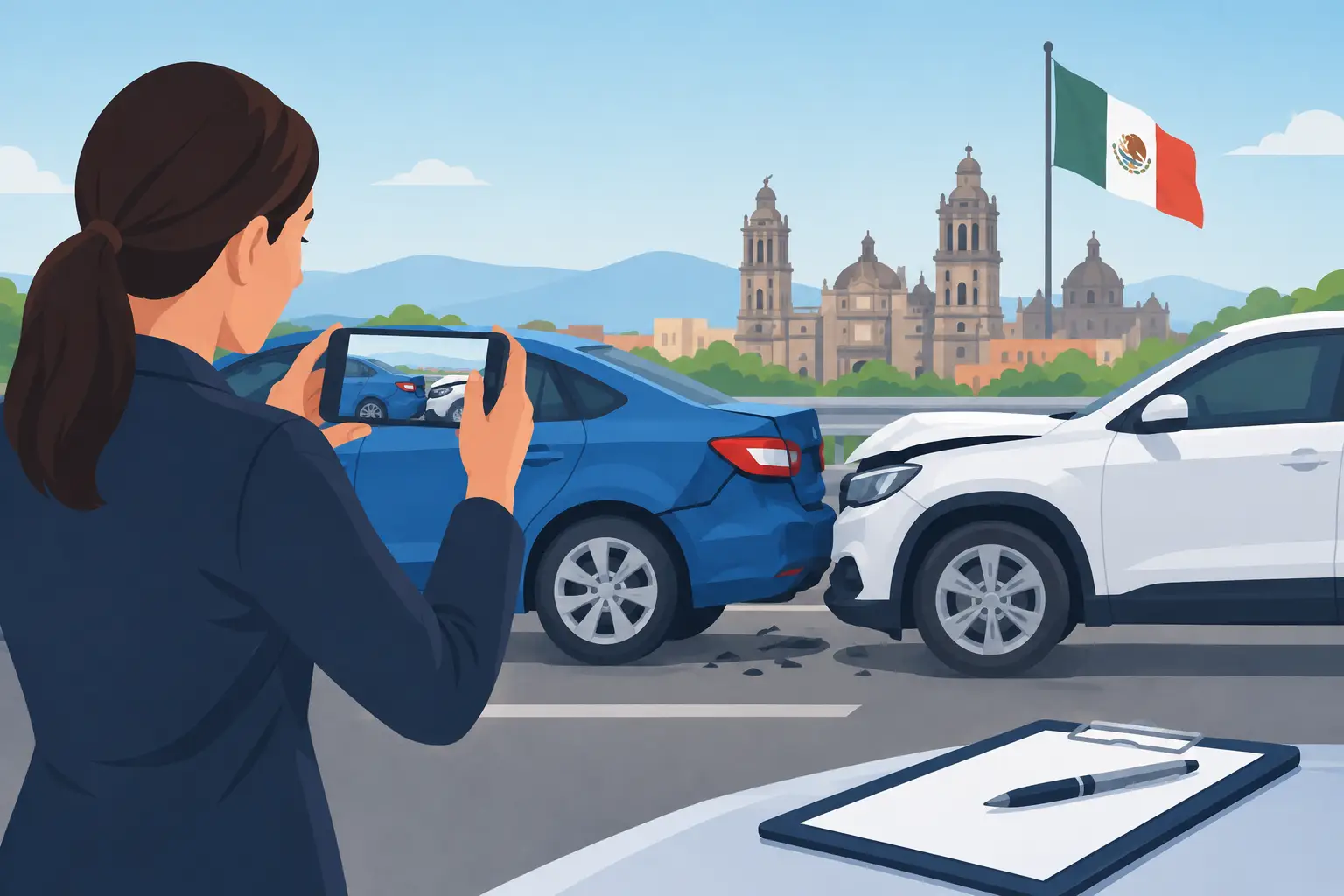
Take clear photos and video as soon as it is safe. Photograph each vehicle, license plates, the road surface, traffic signs, lane markings, debris, nearby landmarks, and visible damage from several angles. If the other driver has insurance documents, photograph those as well rather than relying on handwritten notes alone.
Ask for the other driver’s name, phone number, address, driver’s license details, vehicle registration, and insurance information. If witnesses stopped, get their names and contact numbers. A short video showing vehicle positions and the surrounding roadway can be especially helpful when the facts are disputed later.
Avoid arguing about fault. Do not make promises to pay, sign paperwork you do not understand, or offer a quick cash payment just to get moving. A polite statement such as, “I have called my insurance company and am waiting for the adjuster,” is usually the right response.
Call Your Mexican Insurance Company Promptly
Use the claims telephone number printed on your Mexican policy documents or saved in your phone. Report the accident while you are still at the location whenever possible. Be ready to provide your policy number, your location, a nearby town or kilometer marker, details about injuries, and a brief description of the vehicles involved.
The insurer may dispatch an adjuster, known in Spanish as an ajustador. The adjuster can inspect the damage, gather information, communicate with local authorities, and explain the claims process. This is a major reason to carry Mexican coverage from a company with established local claims support rather than assuming a U.S. auto policy will handle an accident south of the border.
If the vehicle must be moved because it is blocking traffic or creating a hazard, ask the responding officer or insurer for direction first if circumstances allow. Take photos before moving it. In some situations, authorities may direct the move immediately. Follow safety instructions and document what happened.
Mexico Accident Reporting and Police Involvement
Whether police become involved depends on the location, severity of the collision, injuries, property damage, and the parties involved. Police involvement is more likely after an injury, a significant collision, a disagreement about fault, damage to public property, or a crash involving an uninsured driver.
If an officer prepares a report, ask for the officer’s name, agency, report number, and instructions for obtaining a copy. Your adjuster may help you understand what documentation is available and what the insurer needs. Do not assume that a police report by itself settles liability or guarantees payment. It is one piece of evidence, and the insurer will review the facts under the policy terms.
Language barriers can make this stage feel intimidating. Keep your explanation factual and brief. Describe what you saw, where you were traveling, and what happened. If you do not understand a question or a document, ask for clarification and contact your insurer. Guessing or signing an inaccurate statement can create avoidable problems.
When Legal Defense Matters
Mexico handles accident-related legal issues under its own laws and procedures. A serious accident can involve detention, local authorities, civil claims, or criminal allegations, especially when injuries occur. That is why legal-defense coverage is more than a policy add-on for drivers crossing the border.
A strong Mexican tourist auto policy can provide legal assistance and defense-related benefits subject to its limits and conditions. Lewis and Lewis offers Mexican auto coverage with up to $100,000 in legal defense coverage and up to $500,000 combined single-limit liability on qualifying policies. Before your trip, review the declarations page so you know your limits, deductibles, claims number, and any duties you must meet after a loss.
Do Not Rely on U.S. Auto Insurance Alone
Mexican liability insurance is required for driving in Mexico. Your U.S. policy may offer limited protection in certain border areas, but it generally does not meet Mexico’s legal financial-responsibility requirements. A Mexican policy is designed to respond to local claims handling, local authorities, and Mexican liability exposures.
The right coverage depends on your vehicle and travel plans. A family driving a late-model SUV to a resort may need a different policy structure than an RVer towing a vehicle through Baja or a motorcycle rider taking extended trips into mainland Mexico. Liability limits, physical damage coverage, medical payments, roadside assistance, legal defense, and repair options all deserve attention before departure.
For example, a low-cost liability-only policy may satisfy the legal requirement but leave you paying for damage to your own vehicle after a collision. Physical damage coverage can be valuable for a financed truck, motorhome, motorcycle, or vehicle you cannot easily replace. On the other hand, coverage availability, deductibles, and insured-value requirements can differ by vehicle type and age.
If Your Vehicle Needs Towing or Repairs
Do not authorize repairs or agree to a tow until your insurer has been contacted, unless emergency conditions require immediate action. The adjuster may recommend a repair facility, document the vehicle’s condition, or authorize towing. Keep every receipt related to towing, storage, medical care, lodging, transportation, and emergency repairs.
If you drive a U.S.-registered vehicle, ask about repair options before authorizing work. Some policies provide U.S. repair access, which can be especially valuable after a major loss near the border or when you prefer to have repairs completed closer to home. The exact process depends on the insurer, the vehicle’s condition, the location of the accident, and whether the vehicle can be driven safely.
If the other driver offers cash and asks you not to call the insurer, be cautious. A small bumper scuff may hide damage to sensors, lights, suspension components, or a motorcycle frame. Once you accept a private payment and leave, proving the full extent of the loss can be much harder.
Prepare for Mexico Accident Reporting Before You Cross
A few minutes of preparation can make a difficult day far more manageable. Save your Mexican policy and claims phone number in your phone, but also keep a printed copy in the vehicle. Cell service can be unreliable on remote highways, and a damaged phone is not much help after a crash.
Carry your driver’s license, vehicle registration, any required permit documents, and emergency contact information. If you are traveling in an RV, towing a trailer, riding a motorcycle, or driving a vehicle owned by someone else, confirm that your policy accurately describes the vehicle and its use. An incorrect vehicle value, missing trailer information, or an unlisted vehicle type can delay a claim.
It also helps to download offline maps, keep your phone charged, and know the name of the community or highway you are using. “Twenty minutes south of town” is less useful to an adjuster than a route number, a kilometer marker, a GPS location, or a recognizable landmark.
The best time to think about an accident is before your tires cross the border. Carry valid Mexican insurance, know how to reach the claims team, and let the adjuster help manage the scene. That preparation gives you a clearer path forward when the unexpected happens.